

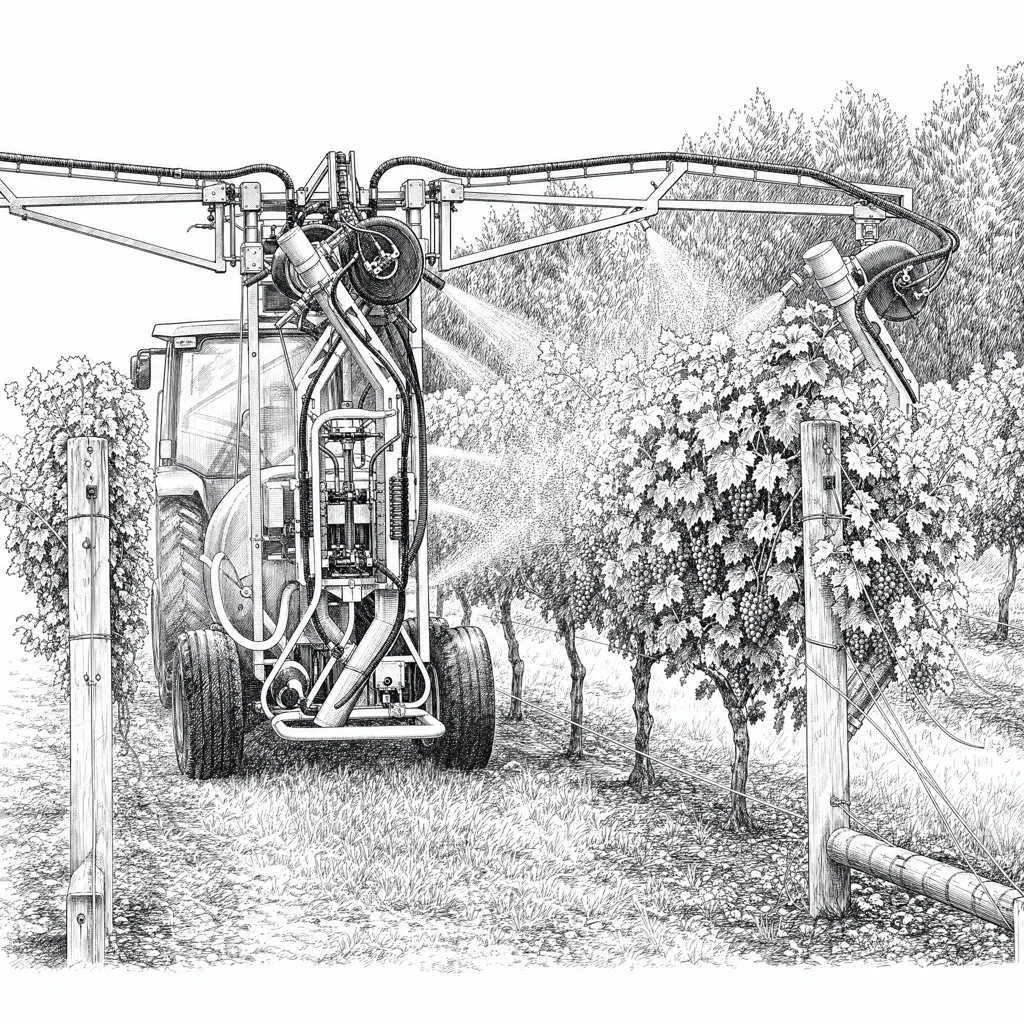
Effective disease control depends on applying the correct dose per hectare and achieving adequate spray coverage throughout the canopy, particularly in the bunch zone.
Even when the correct product is selected and applied at the recommended rate, poor coverage can significantly reduce efficacy. Understanding the relationship between spray volume, concentration and canopy coverage can help improve spray performance and maximise the value of each application.
Common mistakes that reduce spray performance
Many spray application problems can be traced back to a few common issues:
- Applying dilute label rates during concentrate spraying
- Confusing dilute spray volume with applied spray volume
- Assuming higher water volumes always provide better control
- Failing to adjust sprayer settings as canopy size changes
- Not assessing coverage in the bunch zone
- Using excessive travel speeds
- Incorrect airflow or nozzle orientation
Understanding these principles can help improve both spray efficacy and efficiency.
Am I applying the correct dose?
The product dose per hectare must remain constant regardless of the water volume used.
When spray volume is reduced, the concentration of product in the tank must increase to ensure the same amount of product is applied per hectare.
This relationship is described using the concentration factor (CF).
Concentration factor
CF = Dilute spray volume ÷ Applied spray volume
Example
Dilute spray volume = 1500 L/ha
Applied spray volume = 500 L/ha
CF = 1500 ÷ 500 = 3
If the dilute label rate is 100 mL/100 L:
Concentrate rate = 100 × 3 = 300 mL/100 L
The dose per hectare remains unchanged. Only the concentration in the spray mixture changes.
Always follow product label instructions, including any restrictions on concentration factor or maximum concentration.
What is dilute spraying?
Dilute spraying aims to apply enough water to wet the canopy to the point of run-off.
The dilute spray volume depends on factors such as:
- canopy height
- canopy width
- canopy density
- trellis system
Dilute volume provides a reference point for determining the amount of product required per hectare.
It is important to remember that dilute volume is not necessarily the volume that should be applied in practice.
What is concentrate spraying?
Concentrate spraying involves applying the same dose of product using a lower water volume.
Most modern vineyard spraying is undertaken using concentrate spraying because it can improve operational efficiency by reducing tank refilling and increasing work rates.
When using concentrate spraying, the product concentration in the tank must be adjusted using the concentration factor to ensure the correct dose per hectare is maintained.
Am I getting adequate coverage?
Coverage drives efficacy.
For most vineyard pests and diseases, spray droplets need to reach the target area in sufficient quantity to provide effective control.
Particular attention should be given to the bunch zone, which is often one of the most difficult parts of the canopy to cover.
Effective coverage should include:
- outer canopy
- bunch zone
- inner canopy
Good canopy penetration is influenced by:
- airflow
- nozzle type
- nozzle orientation
- spray volume
- travel speed
- canopy density
Applying more water does not necessarily improve control if spray penetration is poor.
Why the bunch zone matters
Many important grapevine diseases affect bunches directly.
If droplets are deposited primarily on the outer leaves and do not penetrate to the bunch zone, disease control may be compromised.
When assessing spray coverage, the bunch zone should be treated as a priority target area.
How do I know if coverage is adequate?
Coverage should be assessed regularly throughout the season, particularly as canopy size and density change.
Useful methods include:
Water-sensitive paper
Water-sensitive cards provide a simple way to assess spray deposition and coverage.
Cards should be placed in:
- outer canopy
- bunch zone
- inner canopy
After spraying, cards can be examined to determine whether droplets are reaching all target areas.
Fluorescent dyes
Fluorescent dyes can provide a more detailed assessment of spray distribution and canopy penetration.
These are particularly useful when evaluating sprayer setup or comparing different spray configurations.
Visual inspection
Regular inspection of canopy wetting patterns can help identify areas receiving inadequate coverage
Adjust sprayer settings as the canopy changes
Canopy size and density change considerably throughout the growing season.
A sprayer setup that performs well early in the season may not provide adequate penetration later in the season.
Sprayer settings should be reviewed as canopy development progresses.
Parameters that may require adjustment include:
- airflow rate
- air direction
- nozzle selection
- nozzle orientation
- spray volume
- travel speed
Key take-home messages
- Maintain the correct dose per hectare regardless of water volume.
- Dilute volume is a reference point used to calculate product rates.
- Coverage is often more important than spray volume.
- The bunch zone is a critical target area.
- Assess coverage regularly using water-sensitive paper or other tools.
- Adjust sprayer setup as canopy size and density change throughout the season.
The AWRI’s agrochemicals project is funded by Wine Australia, with levies from Australia’s grapegrowers and winemakers and matching funds from the Australian Government.
