
Read the latest Ask the AWRI article now.
This article continues a series examining treatments used in the AWRI’s winemaking treatment trials, which have been the subject of tastings staged around Australia since 2016.

Read the latest Ask the AWRI article now.
This article continues a series examining treatments used in the AWRI’s winemaking treatment trials, which have been the subject of tastings staged around Australia since 2016.
Recent wet weather across a number of grapegrowing regions has led to conditions that are favourable to downy mildew infection of grapevines. Infections have been reported across some regions in SA and Victoria. Growers should take action now to minimise crop damage.
To assist growers in dealing with this issue, the AWRI has organised a webinar on downy mildew for this Friday 9 November at 11.30am central daylight time. Barbara Hall from SARDI will review the life cycle of downy mildew and identify the key chemical and cultural strategies to control it. As damage from downy mildew can be followed by Botrytis infection, best practice approaches to managing Botrytis cinerea will also be discussed, including a brief comment on how best to use registered biological fungicides. Register now to attend this webinar. The recording will also be available on the AWRI’s YouTube channel following the webinar.
Key steps to follow to manage the risk of downy mildew are:
Additional useful resources:
Read the latest AWRI Report now.
The AWRI helpdesk responds to queries, conducts investigations and monitors technical trends across the nation’s wine regions, disseminating information via eBulletins, the AWRI website, webinars and face-to-face extension events. This article examines the conditions experienced by growers and winemakers during vintage 2018 and some of the technical challenges encountered.
The October 2018 issue of Technical Review is now available online. Articles and abstracts can be viewed individually, or the full issue can be downloaded. The online format of Technical Review allows you to browse the list of the latest articles on grape and wine production by keyword, view article summaries and order journal articles from the AWRI Library.
For copyright reasons, access to abstracts is available only to Australian winemakers and grapegrowers who pay the Wine Grapes or Grape Research levies. The technical notes authored by the AWRI are, however, freely available. If you have forgotten your password for the AWRI website, please use the forgotten password link to reset your password.
Below is a snapshot of what's in this issue:
| AWRI Technical Notes | |
| AWRI publications |
|
| Current literature – oenology |
|
| Current literature – viticulture |
|
Starting 11 October, Dr Everard Edwards from CSIRO provides insights into how vine balance can directly affect fruit composition. The next five webinars address weather forecasting tools, the benefits of undervine cover cropping, soil salinity, increasing wine flavour, and a Bureau of Meteorology outlook for vintage 2019.
Each webinar includes a presentation and an opportunity for audience members to ask questions and is usually held on a Thursday at 11:30 am Australian Central Daylight Time (Adelaide, GMT+10:30). All AWRI webinars are free to attend.
After registering for a webinar, you will receive a confirmation email with a link to join the session.
The next six webinars for the program are:
11 October 2018: Targeted manipulation of vine balance: does vine balance directly affect fruit composition? – Dr Everard Edwards (CSIRO)
18 October 2018: Unravelling the mystery of probability in weather and climate forecasts – Veron Carr (Bureau of Meteorology)
25 October 2018: Vine medication – the benefits of undervine cover cropping – Chris Penfold (University of Adelaide)
8 November 2018: Salinity – practical information for growers – Kerry DeGaris (AWRI)
20 November 2018: Increasing wine flavour with glycoside additions – Mango Parker (AWRI)
6 December 2018: Bureau of Meteorology Seasonal Outlook for vintage 2019 – Darren Ray (Bureau of Meteorology)
System requirements
You will need a computer or mobile device with an internet connection. Audio is connected over the internet using your computer or mobile device’s speakers (Voice over Internet Protocol – VOIP). Participants joining a webinar via a mobile device will need to download a free app available from iTunes or Google Play.
If you’ve missed a previous AWRI webinar, you can watch online via the AWRI’s YouTube channel.
For further information on AWRI webinars, please contact the AWRI information services team.
High-quality genome assembly for Chardonnay released
Project to demonstrate value of sustainable practices
New technique to study Brettanomyces yeast
Software shared with research community
Looking for answers? Browse the ‘Ask the AWRI’ archive
High-quality genome assembly for Chardonnay released |
|
 |
Chardonnay is the basis of some of the world’s most iconic wines and its success is underpinned by a historic program of clonal selection. With numerous clones available showing differences in key viticultural and oenological traits, the potential diversity of Chardonnay wines and blends has never been greater. Despite this, the genetic variation that underlies most of these differences has, for a long time, remained a mystery. The AWRI, in collaboration with partners at Macquarie University, the University of British Columbia, and the British Columbia Cancer Research Centre, spearheaded an ambitious project to produce a high-quality genome assembly for Chardonnay and use this to unravel the great puzzle that is clonal genetic diversity.
The AWRI’s bioinformatics team identified 1,620 genetic markers that distinguish 15 Chardonnay clones. These markers were used in a proof-of-concept experiment to reliably identify Chardonnay clones, and many of the markers were identified as having the potential genetics to explain some of the differences between clones. The most surprising finding however involved the genetic analysis of Chardonnay’s parents—Pinot Noir and Gouais Blanc. While Chardonnay might be a noble cultivar, it has a less than dignified heritage. The genomic data shows evidence of inbreeding – with Gouais Blanc and Pinot Noir potentially being first-degree relatives. More work is required to develop a method for Chardonnay clonal authenticity testing, as well as testing to determine the viticultural and oenological effects of the markers. However, the groundwork has been laid for a much better understanding of the Chardonnay genome, and of clonal variation within grapevine cultivars. |
Project to demonstrate value of sustainable practicesThe AWRI has been successful in achieving funding for a new project as part of the Food Agility CRC. This collaborative project with Queensland University of Technology (QUT) and National Australia Bank (NAB) will bring together traditional agricultural financial risk assessment and natural capital accounting to gain new insights into the value of sustainability investments and practices. Preliminary models will be developed and potential sustainability indicators will be identified. The project will lead to improved assessment of business sustainability, decreased investment decision risk and improved access to finance by growers. Phase one of the project will be the identification by the QUT research team of potential financial parameters from the natural capital literature and through interviews with NAB frontline bankers, agronomists and growers. This will be followed by collection of financial and environmental data including energy, water and fertiliser use, from a pilot group of growers through the Entwine survey. Preliminary modelling will be focused on generating insights and patterns of related metrics to inform the broader data analytics and on which to base grower case studies that demonstrate improved economic returns achieved using sustainable practices and investments. Deeper analysis of the larger Entwine dataset will highlight the dependencies of relationships across metrics, identify critical factors in financial decision-making and provide preliminary benchmarking of financial performance. Upon the completion of this research, the AWRI will communicate the project results and discuss future research directions with wine industry stakeholders. For more information about this project, contact Dr Mardi Longbottom on 08 8313 6600 or mardi.longbottom@awri.com.au. |
|
New technique to study Brettanomyces yeast |
|
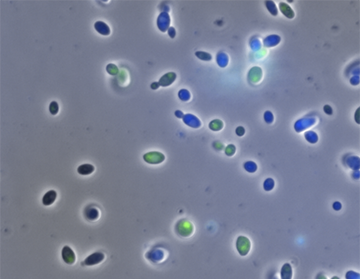 |
Genetic transformation is a foundational technology that enables the comprehensive study of a species. When available, it opens up a multitude of molecular biology tools, such as gene overexpression, gene deletion, incorporation of marker genes and tagging for visualisation or purification. Transformation has been available in Saccharomyces cerevisiae for well over 30 years, with much of the knowledge that has been generated for this species due to the early development of this technique. While, genetic transformation for Brettanomyces bruxellensis was developed recently, it suffered from a very low efficiency that limited the scope of tools that could be developed. To address these shortcomings, AWRI scientists have developed a new gene transformation protocol for B. bruxellensis.
As part of this process constructs have been created which enable Brettanomyces cells to be labelled with either green- or blue- fluorescent proteins. Cells that express these proteins glow when exposed to certain wavelengths of light and this enables the rapid identification and counting of these cells during fermentation. This work has recently been published in FEMS Yeast Research. The full paper is accessible via the AWRI library: Varela, C., Lleixà, J., Curtin, C., Borneman, A. Development of a genetic transformation toolkit for Brettanomyces bruxellensis. FEMS Yeast Res. 18(7): 1-6; 2018. |
Software shared with research communityAWRI scientists based within Metabolomics South Australia have just released a piece of code (known as MStractor, written in the R programming language) on the software development and sharing platform GitHub. The software is designed to help researchers process data from non-targeted liquid chromatography mass spectrometry (LC-MS) experiments and can be downloaded for free by any interested party from https://github.com/MetabolomicsSA/MStractor. This is one example of a relatively new area for AWRI scientists to be involved in – sharing code that has been written in-house with the broader research community via an open access licence. Metabolomics SA is the South Australian node for Metabolomics Australia – a nationwide, government-funded initiative established to enable the development of, and access to, state-of-the-art metabolomic analysis, through investment in infrastructure, method development, collaboration and integration. Metabolomics Australia acknowledges funding and leadership from Bioplatforms Australia under the National Collaborative Research Infrastructure Strategy. The term metabolomics refers to the comprehensive analysis of the complete set of all low molecular weight metabolites that exist within a biological system such as grape juice or wine. For more information about Metabolomics SA, contact the team on metabolomics@awri.com.au. |
|
Looking for answers? Browse the ‘Ask the AWRI’ archive |
|
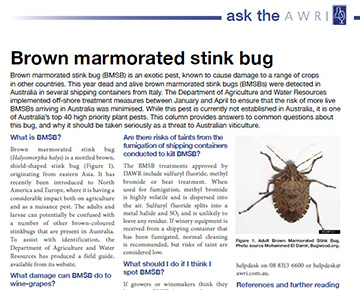 |
Since 2012 the AWRI’s helpdesk team has published a monthly ‘Ask the AWRI’ column in Australian & New Zealand Grapegrower and Winemaker. Each column focuses on a technical issue relevant to growers or winemakers and provides practical information in a Q&A format. The full archive of Ask the AWRI columns is now available on the AWRI website, with permission from the publisher, Winetitles. So, if you would like to know more about carbonic maceration, spray drift, taints in wine or countless other topics, check out the collection now. |
Events across AustraliaAs spring gets underway, there are a number of workshops and seminars coming up in wine regions across Australia. The AWRI’s ‘Addressing regional challenges’ workshop will be held in Mudgee, Orange and Canberra from 9 to 11 October. These workshops present regional-specific data and include information on the latest technologies and process options for grapegrowing and winemaking, with specific topics selected by each regional association. AWRI seminars will be held in Western Australia (Mt Barker, Pemberton, Margaret River and Swan Valley) from 6 to 9 November and in Victoria (Gippsland, Mornington Peninsula, Geelong and Yarra Valley) from 27 to 30 November. These will feature a selection of presentations covering the latest in viticulture and wine research. Workshops on spray application are also planned for Stanthorpe, Orange and Canberra from 13 to 16 November. Visit the AWRI events calendar now for a full list of upcoming events or contact the events team on events@awri.com.au or 08 8313 6600 for more information. |
|
Order the latest AWRI staff publications onlineAccessing the latest AWRI publications is easy. Visit the AWRI Publications web page to:
A list of AWRI publications published since the last eNews is included below: 2023 Kontoudakis, N., Mierczynska-Vasilev, A., Guo, A., Smith, P.A., Scollary, G.R., Wilkes, E.N., Clark, A.C. Removal of sulfur-bound copper from white wine by membrane filtration. Aust. J. Grape Wine Res. DOI: 10.1111/ajgw.12360: 1-9; 2018. 2024 Varela, C., Lleixà, J., Curtin, C., Borneman, A. Development of a genetic transformation toolkit for Brettanomyces bruxellensis. FEMS Yeast Res. 18 (7): 1-6; 2018. 2025 Hendriks, H.F.J., Stockley, C.S., Calame, W. The 2015 Dutch food-based dietary guidelines for alcohol consumption – a critical review. J. Nutr. Health Sci. 5 (3): 1-9; 2018. 2026 Hixson, J., Grebneva, Y., Glameyer, N., Vollmern K. Black, C., Krstic, M., Herderich, M. Shedding light on the modulation of key Riesling wine aroma compounds in a changing climate. Siegmund, B., Leitner, E. (eds.) Flavour Science: Proceedings of the XV Weurman Flavour Research Symposium, 18-22 September, 2017, Graz University of Technology, Austria. Graz, Austria; Verlag der Technischen Universität Graz. 19-24; 2018. 2027 Parker, M., Barker, A., Pearson, W., Hayasaka, Y., Hixson, J., Francis, L. Flavour release from wine glycosides during tasting. Siegmund, B., Leitner, E. (eds.) Flavour Science: Proceedings of the XV Weurman Flavour Research Symposium, 18-22 September, 2017, Graz University of Technology, Austria. Graz, Austria; Verlag der Technischen Universität Graz. 31-36; 2018. 2028 Hixson, J.L., Durmic, Z., Vadhanabhuti, J., Vercoe, P.E., Smith, P.A., Wilkes, E.N. Exploiting compositionally similar grape marc samples to achieve gradients of condensed tannin and fatty acids for modulating in vitro methanogenesis. Molecules 23 (7): 1-13; 2018 2029 Siebert, T.E., Barter, S.R., Pearson, W., de Barros Lopes, M.A., Darriet, P., Herderich, M.J., Francis, I.L. Why does this wine smell like apricots? Siegmund, B., Leitner, E. (eds.) Flavour Science: Proceedings of the XV Weurman Flavour Research Symposium, 18-22 September, 2017, Graz University of Technology, Austria. Graz, Austria; Verlag der Technischen Universität Graz. 245-248; 2018. 2030 Stockley, C.S. Ask the AWRI: Alcohol during pregnancy and breastfeeding. Aust. N.Z. Grapegrower Winemaker (655): 83-84; 2018. |
|
AcknowledgementsThe AWRI acknowledges support from Australia’s grapegrowers and winemakers through their investment body, Wine Australia, with matching funds from the Australian Government. The AWRI is a member of the Wine Innovation Cluster in Adelaide, South Australia. |
|
The Department of Agriculture and Water Resources (DAWR) has announced that mandatory fumigation and/or heat treatment will be applied to high risk imported goods shipped between 1 September 2018 and 30 April 2019 as a seasonal measure to protect Australian agricultural industries from the brown marmorated stink bug (BMSB). Wood products such as oak barrels and cork have been categorised as one of a range of high risk products for biosecurity incursions and will require mandatory treatment. Other winemaking additives may also be subject to treatment through random inspection or if they are part of a consignment that contains target high risk goods.
A recent media release issued by WFA and WISA details the likely additional lead times and costs for shipment, treatment and clearance of imported products for vintage 2019. This eBulletin addresses concerns over possible implications of these treatments on oak barrels and other winemaking products.
Fumigation
The two fumigation treatments announced by DAWR are methyl bromide or sulfuryl fluoride. These agents have been used as insecticides for more than 50 years, mainly due to their toxicity to a wide variety of pests and their ability to rapidly penetrate into materials and then dissipate after aeration leaving minimal, if any, residue.
Winemakers may be concerned about the possibility of taints resulting from the fumigation of oak barrels. The AWRI has carefully considered the chemistry of formation of halophenol and haloanisole taints and reached the opinion that the fumigation of oak barrels with methyl bromide or sulfuryl fluoride is highly unlikely to cause such a taint unless a strong oxidising agent (e.g. hypochlorite or ozone) is also present, or unless the barrel is already tainted with a halophenol.
The AWRI’s helpdesk has not encountered any issues in the past of taints resulting from fumigation of oak barrels. However, if an oak barrel has a high moisture content, there is a possibility it could contain residual bromide (from methyl bromide) or fluoride (from sulfuryl fluoride) ions after fumigation. Consequently, it is advisable for fumigated barrels to be filled with treated (i.e. chlorine-removed) water for 48 hours after airing, to minimise the risk of residual bromide or fluoride ions.
There is also potential that winemaking additives and processing aids present in fumigated containers could adsorb methyl bromide or sulfuryl fluoride, and that it could take some time for the adsorbed fumigants to dissipate.
Heat treatment
The third treatment option put forward by DAWR is for containers to be heat treated at 50 degrees Celsius or higher for at least 20 minutes. Note that the DAWR website only lists offshore treatment providers, so it appears that heat treatment must be performed before departure from the country of origin. A possible issue arising from heat treatment is the drying out of oak barrels and the resulting potential for leakage.
What to do if a pest is found?
The AWRI advises grapegrowers and winemakers who transport or receive goods from overseas to be vigilant in checking for BMSB and other biosecurity risks. If any type of live pest is found while unpacking or moving goods, it must be reported immediately to the DAWR Hotline on 1800 798 636. If a live pest is found:
If growers or winemakers think they have seen BMSB (or any other exotic pest) in the vineyard or winery, they should phone the Exotic Plant Pest Hotline on 1800 084 881.
For further information on methyl bromide and sulfuryl fluoride, including their chemical reactions and relevant research papers used in the preparation of this eBulletin, please contact the AWRI helpdesk on 08 8313 6600 or helpdesk@awri.com.au.
Disclaimer
The AWRI has prepared this eBulletin based on a review of available relevant research papers. The information presented is for guidance only; the AWRI has not performed any research on the effects of fumigation on oak or other products with the above-mentioned fumigants, and therefore cannot guarantee that adverse effects will not occur. Winemakers that have concerns over residual levels of methyl bromide or sulfuryl fluoride in fumigated barrels are advised to have the barrels tested by a reputable laboratory and not to rely solely on the information contained in this eBulletin.
As the spray season gets underway across Australia’s wine regions, this is a good time to think about some of the key factors that ensure safe and effective spray practices for pest, disease and weed control.
Selection of chemicals
Only use chemicals registered for use on grapevines. Refer to the ‘Dog book’ for a full list of registered and recommended chemicals. Rotate chemicals to avoid agrochemical resistance. Follow the CropLife Australia chemical resistance management strategies on pages 15 – 18 of the ‘Dog book’ and in the AWRI fact sheet on managing chemical resistance.
Chemical labels
Agrochemical labels are legal documents that must be observed. Always follow the label recommended application rates, recommendations for personal protective equipment and re-entry periods. Label withholding periods (WHPs) provide a guide which assumes that the wine will be sold in Australia. The ‘Dog book’ WHP recommendations assume that the wine will be sent to a range of overseas markets, each with differing maximum residue levels (MRLs). If you only sell wine in Australia, or to only a few countries, contact the AWRI to discuss how the recommendations might differ. The AWRI can also provide advice regarding the persistence of chemicals on grapes or through winemaking. MRLs for most major export destinations can be found in the AWRI’s MRL database.
Record-keeping
It is a label requirement that specific details of all agrochemical applications be kept for a minimum of two years. Australian states and territories also have their own legislation regarding accreditation for applicators, information to be recorded and the length of time for which records must be kept. The AWRI, in collaboration with industry, has developed a spray diary format and set of terminology that meets basic winery requirements. It is, however, recommended that growers follow applicable state or territory rules and check with their winery or grape purchaser in case additional information is required.
Agrochemical application
Effective chemical control is dependent on the correct timing, coverage and application rate. A number of fact sheets on spray application are available from the spray application page of the AWRI website. Key points to consider include:
For more information on spray application or any other grape and wine technical issues, please contact the AWRI helpdesk on (08) 8313 6600 or email helpdesk@awri.com.au.
The AWRI has released five sessions to launch the 2018-19 webinar program. Registration via the AWRI website is now open!
First up, the AWRI’s Josh Hixson reveals the vineyard and winery drivers associated with formation of aged characters in Riesling. The next four webinars address the latest in biosecurity news, use of antitranspirants as a tool to help combat vintage compression, global supply and demand trends in key export markets and compounds responsible for ‘apricot’ aroma in white wine.
Each webinar includes a presentation and an opportunity for audience members to ask questions and is held on a Thursday at 11:30 am Australian Central Standard Time (Adelaide, GMT+09:30). All AWRI webinars are free to attend.
The next five webinars for the program are:
30 August 2018: The flavour of bottle-aged Riesling – predicting and controlling future chemistry – Dr Josh Hixson (AWRI)
6 September 2018: Biosecurity – current and future risks – Dr Mardi Longbottom (AWRI)
13 September 2018: Antitranspirants – can they enhance wine-grape production? – Darren Fahey (DPI NSW)
27 September 2018: State of play – key markets for Australian wine – Kirstin Hannan (Wine Australia)
4 October 2018: Why does this wine smell like apricots? – Dr Tracey Siebert (AWRI)

After registering for a webinar, you will receive a confirmation email with a link to join the session.
System requirements
You will need a computer or mobile device with an internet connection. Audio is connected over the internet using your computer or mobile device’s speakers (Voice over Internet Protocol – VOIP). Participants joining a webinar via a mobile device will need to download a free app available from iTunes or Google Play.
If you’ve missed a previous AWRI webinar, you can watch it online via the AWRI’s YouTube channel
For further information on AWRI webinars, please contact the AWRI information services team.
The August 2018 issue of Technical Review is now available online. Articles and abstracts can be viewed individually, or the full issue can be downloaded. The online format of Technical Review allows you to browse the list of the latest articles on grape and wine production by keyword, view article summaries and order journal articles from the AWRI Library.
For copyright reasons, access to abstracts is available only to Australian winemakers and grapegrowers who pay the Wine Grapes or Grape Research levies. The technical notes authored by the AWRI are, however, freely available. If you have forgotten your password for the AWRI website, please use the forgotten password link to reset your password.
Below is a snapshot of what's in this issue:
| AWRI Technical Notes | |
| AWRI publications |
|
| Current literature – oenology |
|
| Current literature – viticulture |
|